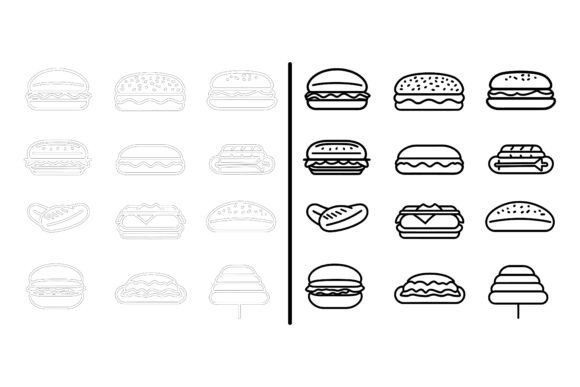
Maximizing Creative Potential with Fastfood Illustrations Collections
The digital landscape thrives on visual content that captures attention and communicates clearly. Within niches like food services, a targeted fastfood illustrations collection can become an indispensable asset. These packs are not merely a bundle of pictures but a structured resource engineered for flexibility and ease of use. They empower a wide spectrum of professionals—from freelance graphic designers and marketing specialists to restaurant owners and app developers—to produce consistent, high-quality material without starting from scratch each time.
Technical Backbone of Modern Vector Collections
The tangible value of an illustration set begins with its technical specifications. Providers who understand the workflow of creative professionals deliver products that integrate instantly into existing pipelines.
File Types: Beyond Basic Compatibility
The inclusion of AI, EPS, and JPG files caters to very distinct stages of a project. The master AI file houses the completely editable vector artwork, often with paths, strokes, and fills that can be manipulated down to the anchor point. This is crucial for projects that may require the deconstruction of a graphic to animate it in After Effects or build a custom icon set in XD. The EPS file functions as a reliable archival and exchange format. It preserves the vector integrity while being importable into non-Adobe programs like Inkscape, and even older print machines that rely on PostScript. The JPG serves as a convenient thumbnail and a ready-to-use web image when vectors are overkill. This three-pronged approach means the collection is equipped to handle everything from intricate custom work to rapid content deployment.
A Deep Dive into Cross-Platform Engineering
An often underappreciated but vital feature is that the set is designed for Mac and Windows users. This involves more than just saving files in a common format. It requires internal referencing, like linked images and fonts, to be handled through relative paths or embedded. It ensures that compound vector shapes and clipping masks render identically irrespective of the GPU or rendering engine of the operating system. For a business, this guarantees that a designer in New York working on a Mac can share native files with a client’s designer in London using Windows, and both will see precisely the same layout, colors, and details. This seamless collaboration is a foundation of modern distributed work environments.
Architecture of Order: Inside the File and Layer Structure
Time lost searching for assets or fixing disorganized layers is time wasted. A professional-grade collection treats organizational clarity as a feature, not an afterthought.
How a Neatly Organized Structure Fuels Productivity
When a product highlights a neatly organized, file, and layer structure, it promises that each document is a model of efficiency. Top-level layers are typically pre-named and ordered, such as “Backgrounds,” “Food Items,” “Accents,” and “Shadows.” Grouped elements within those layers allow for the simultaneous transformation of all constituent parts of a graphic. For example, a taco icon might be a group containing “Shell,” “Fillings,” and “Garnish.” An artist can click once to scale the entire group or double-click to enter the group and tweak just the green of the cilantro. This hierarchical logic dramatically lowers the learning curve, enabling even those with intermediate software skills to produce expert-level edits swiftly.
Uncompromising Quality and Stylistic Harmony
Visual consistency is the silent communicator that builds brand trust. A jarring mix of icon styles on a single app screen can erode user confidence, whereas a unified visual language strengthens it.
The Mark of Professionalism: Detail and Consistency
Adherence to perfection in details and consistency means that each illustration has been crafted under a strict set of design rules. Shadows fall in the same direction, color highlights use a unified global palette, line art maintains a consistent weight, and curves are anchored with precise bezier handles. This attention to detail ensures that when you place a hot dog icon next to a coffee cup icon, they feel like they belong to the same family. For a restaurant brand, this translates directly into digital and print materials that feel premium and thoughtfully curated. It suggests to the customer that the same care put into the branding is put into the food.
The Universal Adaptability of Vector Artwork
These sets are specifically suitable for print, web, symbols, apps, and infographics, covering the full spectrum of modern communication. In print, the vectors can be used for large-format window decals where a single french fry might be three feet tall, yet it remains razor-sharp. For the web, SVGs exported from these files can be styled via CSS, allowing for hover effects, dark mode adaptations, and smooth animations that bring a menu page to life. In app design, they become the universally understood symbols for order, menu, favorite, or dietary tags. In infographics, a carefully placed series of food icons can convey consumption statistics, market trends, or menu composition far more effectively than text alone. This multi-media suitability ensures that the asset grows with your brand, from a startup’s first mobile site to a franchise’s coordinated nationwide signage.
The Freedom of Unrestrained Modification
True creative autonomy means never having to accept a pre-set color or shape. The intrinsic value of a vector collection is fully realized when it acts as a raw material for new ideas.
Customization Simplified: Edits, Colors, and Icon Morphing
The capability that you can edit it, change colors and modify the icon so easily according to your needs is empowering. Changing the color palette of an entire food set from a fast-food vibe to a sophisticated, minimalist palette is achieved through global color swatches—editing one master swatch can update dozens of icons instantly. Beyond color, the modular nature of well-built vectors means components can be repurposed. The sesame seeds from a burger bun can be copied onto a bagel. The steam rising from a coffee cup can be isolated, colored, and used as a dynamic background element. This level of modifications supports rapid prototyping and allows a small marketing team to generate a vast array of campaign-specific graphics without external design support.
Seamless Adoption and Long-Term Utility
The final measure of a resource is not just its initial quality but its ongoing usefulness and ease of adoption into the daily rhythm of content creation.
Fast-Tracking Creative Projects to Completion
Integrating a fastfood illustrations collection into your digital library sets up a powerful shortcut. Whether you are wireframing a food ordering UI in Figma, designing a promotional poster in Photoshop, or drafting a weekly email newsletter in Canva, having a known library of high-quality, easily editable graphics removes the biggest bottleneck: asset creation. The initial investment in a well-crafted set pays dividends by freeing up creative energy to focus on layout, copywriting, and strategy. For educators and students, these packs serve as excellent tools for learning vector editing techniques on a structured, professional-grade canvas. For agencies, they form a shareable starting point for mockups, helping to communicate complex ideas to clients visually before committing to custom illustration work. The result is a consistent visual output that elevates the perceived quality of any project, from a simple fast-casual lunch menu to an integrated brand identity system.