Moon and Star Isolated: Creative Vector Design Ideas
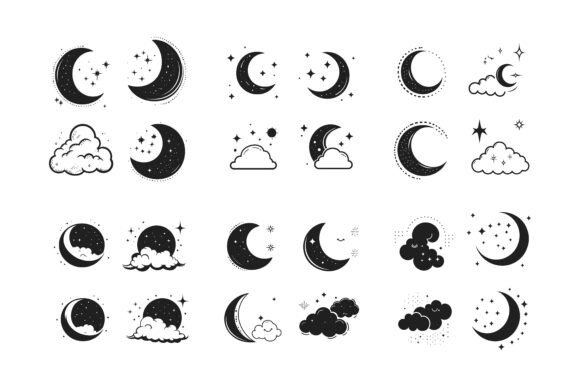
Celestial imagery has always held a special place in visual storytelling. The moon and star isolated motif, stripped of distracting backgrounds and presented as a clean vector element, gives creators remarkable flexibility. Whether you are building a brand identity, crafting an infographic, or designing app icons, these standalone graphics adapt without resistance. They carry a quiet universality that resonates across cultures and contexts, making them one of the most reliably useful assets in a designer's toolkit.
What makes the Moon and Star Isolated collection particularly interesting is how it balances simplicity with emotional weight. A crescent paired with a single star can evoke wonder, guidance, or calm depending on how you deploy it. The isolation of the elements means you control the narrative entirely. There is no imposed scene, no predetermined mood. You place the graphic where it belongs in your composition, and the meaning follows naturally.
Why Isolated Celestial Graphics Work Across So Many Projects
Isolated graphics remove a common friction point in design workflows. When a moon and star element arrives without a baked-in background, you skip the tedious step of masking or clipping. You drop it directly onto a business card layout, a website header, or a product label, and it integrates immediately. This practical advantage saves minutes on every project, and those minutes compound across client work and deadlines.
Beyond the technical convenience, there is a deeper design principle at play. Celestial symbols like moons and stars carry layered associations. They reference nighttime, dreams, exploration, spirituality, and natural cycles. A Moon and Star Isolated graphic can function as a literal night-sky illustration or as a metaphorical marker for aspiration and guidance. The same asset works for a children's bedtime story app and a meditation brand's packaging. The versatility comes from the symbol itself, but the isolation keeps that versatility intact.
Practical Applications for Different Creative Roles
Designers, marketers, and small business owners each approach the same graphic with different intentions. Understanding how your specific context shapes usage helps you extract more value from the collection.
For Brand Identity Designers
A moon and star combination works beautifully as a logomark or secondary brand element. The AI EPS format means you can scale the graphic from a favicon to a storefront sign without losing crispness. You can adjust stroke weights, tweak the crescent curve, or recolour the entire element to match a brand palette. This level of editability is essential when a client asks for a subtle adjustment during a presentation. Instead of rebuilding the graphic, you modify it directly and keep the meeting moving.
Consider a wellness brand that wants a logo conveying restfulness. The moon and star icon, rendered in a muted gold against a deep navy background, communicates exactly that. The same icon, recoloured in bright white and placed on a bold gradient, can feel modern and energetic for a tech startup. The graphic does not change. The context does.
For Web and App Designers
Interface design demands clarity at small sizes. Celestial icons used as navigation elements, loading indicators, or feature badges need to remain legible when scaled down. The Moon and Star Isolated graphics, built with attention to detail and consistent line weights, hold their form even at minimal dimensions. The organised layer structure in the source file lets you isolate the moon or star individually, giving you two usable assets from one composition.
Dark mode interfaces benefit especially from celestial iconography. A subtle moon icon in a settings menu or a star used as a favourite button feels intuitive and thematically coherent. Users recognise these symbols instantly, which reduces cognitive load and improves the overall experience. When you have the AI EPS source file, you can export at any resolution needed for iOS, Android, or web without quality degradation.
For Print and Publication Designers
Print projects demand high-resolution assets with predictable colour output. The included JPG files provide ready-to-use raster versions, but the vector source gives you complete control over separations and spot colours. A magazine layout featuring a moon and star motif in the folio or section dividers can maintain consistency across hundreds of pages because the source graphic remains identical at every instance.
Greeting card designers, poster artists, and book cover creators often need decorative elements that frame content without overwhelming it. A gently curved moon paired with a small star creates breathing room in a composition. It anchors the eye without demanding attention. The isolated nature of the graphic means it layers cleanly over photography, illustration, or solid colour fields.
For Educators and Content Creators
Presentation slides, worksheets, and digital learning materials benefit from clear visual cues. A moon and star graphic can mark sections about astronomy, mythology, poetry, or nighttime routines. Teachers and educational content creators who need to adapt materials for different age groups will appreciate how easily the colours and scale can be modified. A bright yellow cartoonish version works for elementary students. A more restrained, elegant version suits adult learners.
Bloggers and social media content creators can use these graphics to build consistent visual templates. A recurring celestial motif in post headers, quote cards, or story highlights creates a recognisable aesthetic. Followers begin to associate the imagery with the content, strengthening brand recall over time.
How the AI EPS Format Enhances Creative Flexibility
Vector formats like AI EPS are foundational to professional design work. Unlike raster images that pixelate when enlarged, vector graphics use mathematical paths that remain sharp at any size. This matters practically when a graphic created for a mobile screen needs to appear on a trade show banner three metres wide. You scale it, and the edges stay perfect.
The editability extends beyond scaling. You can change fill colours, adjust stroke properties, modify anchor points, and even deconstruct the graphic into its component shapes. If a project requires only the star portion of the composition, you open the file, select the moon path, and delete it. If you need the crescent thickened or the star points sharpened, you make those adjustments directly. This granular control means the graphic bends to your vision, not the other way around.
The neatly organised file and layer structure mentioned in the collection description is not a minor detail. Opening a vector file to find properly named layers and logical grouping saves real time. You spend fewer minutes deciphering someone else's workflow and more minutes actually designing. For designers who handle multiple client files daily, this organisational clarity reduces friction significantly.
Maintaining Consistency Across Multiple Project Files
When a single graphic appears across dozens of deliverables, consistency becomes a quality benchmark. A moon and star icon used in a brand's website header should match the version on their business cards, social media templates, and product packaging. Slight variations in proportion or colour temperature erode the polished feel of a brand identity.
Using the same source AI EPS file as the single source of truth prevents these inconsistencies. You export the graphic at the required dimensions and colour profiles for each platform, but the underlying geometry never drifts. This disciplined approach reflects well on your professionalism and spares you the embarrassment of a client noticing mismatched branding elements.
Adapting Celestial Graphics for Different Audiences and Contexts
The moon and star motif carries different connotations depending on cultural context, colour treatment, and surrounding content. A designer working on Ramadan-themed materials might use a crescent moon and star with warm golds and deep blues. A Halloween event poster might feature the same basic shapes rendered in eerie green against black. A nursery décor brand might soften the graphic with pastel tones and rounded stroke caps.
Understanding your audience helps you make intentional choices about how to present the graphic. The Moon and Star Isolated collection does not lock you into one interpretation. You receive neutral, well-constructed vector shapes that take on meaning through your creative decisions. This neutrality is a feature, not a limitation. It respects your expertise as the designer who understands the end user.
Accessibility considerations also come into play. Ensure sufficient contrast between the graphic and its background, especially when used as an interface element. The moon and star should remain distinguishable for users with visual impairments. Since you control the colours entirely through the editable vector file, meeting accessibility standards is straightforward.
Organising Your Asset Library for Efficient Workflows
Creative professionals accumulate thousands of graphic assets over time. Without a system, finding the right element becomes a memory game you will eventually lose. When you add a collection like this to your library, take a few minutes to tag it properly. Note the style, the subject matter, the file formats included, and potential use cases.
The fact that this collection is designed for both Mac and Windows users eliminates platform compatibility concerns. Team members on different operating systems can access and edit the files without conversion issues. Cross-platform compatibility is easy to overlook until you encounter a file that refuses to open correctly on a colleague's machine.
Realistic Examples of Moon and Star Isolated in Finished Projects
Imagine a freelance designer creating a sleep-tracking app. The moon icon appears as the app logo, a star marks user achievements, and a combined moon-and-star graphic decorates the onboarding screens. All three uses pull from the same source file, maintaining visual harmony across the entire product.
Consider a small bakery launching a new line of evening dessert boxes. The packaging features a stamped moon and star in gold foil on dark cardboard. The same graphic appears on the website banner, the social media announcement, and the printed menu inserts. The isolated vector file made it easy to prepare print-ready separations and web-optimised PNGs from one master graphic.
Think about an educator designing a unit on space exploration. The moon and star graphics appear in slide decks, handouts, classroom posters, and digital quizzes. The ability to recolour the graphics quickly means the same shapes can appear in different colour schemes for different age groups or topics without creating visual fatigue.
Final Thoughts on Making the Collection Your Own
A well-crafted graphic collection provides a starting point, not a finished solution. The value comes from what you do with it. The Moon and Star Isolated collection, with its editable vector format, organised structure, and cross-platform compatibility, gives you the raw materials to build something tailored to your specific project needs. You modify, recolour, scale, and compose until the graphic feels like it was created for your project alone.
Take time to explore the file after downloading. Click through the layers. Experiment with colour swaps and scale tests. Try the graphic in contexts you did not initially consider. The creative possibilities of a simple, well-made celestial graphic extend further than first impressions suggest. When you invest in assets that prioritise editability and thoughtful organisation, you invest in faster workflows and stronger finished work.