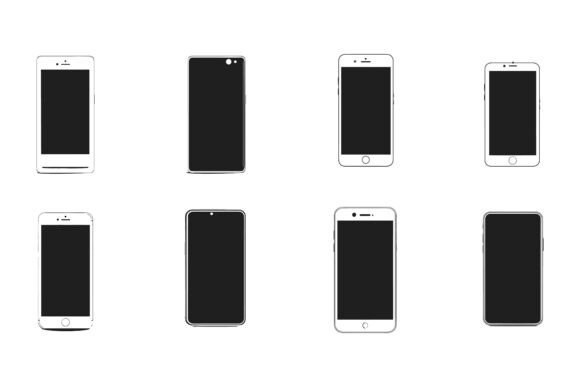
White Mobile Phone Model
Few design assets strike the balance between simplicity and versatility as effortlessly as a well-structured white mobile phone model. Part of a special AI EPS collection built for modern creators, this illustration set transforms a familiar object into a launchpad for countless visual ideas. It’s not just a picture of a device—it’s an editable, organized toolkit that adapts to your project, whether you’re refining a client pitch, populating a blog post, or crafting an entire brand identity. The clean white finish offers a neutral starting point, while the behind-the-scenes layer structure gives you the kind of control that turns a good composition into something genuinely your own.
What Makes This White Mobile Phone Illustration Set Stand Out?
Many designers, marketers, and small business owners know the frustration of downloading a graphic only to find a flattened, unusable file. This collection takes the opposite approach. At its core, the asset thrives on thoughtful organization. Every element—from the device frame and subtle highlights to the screen area and tiny functional details—lives on its own named layer. That means you open the file and immediately understand what you can move, tweak, or hide. For busy professionals, that clarity saves time and reduces creative friction.
The file package itself is deliberately cross-platform. Whether you work on a Mac or a Windows machine, you’ll find the AI (Adobe Illustrator) and EPS versions ready to use, alongside a handy JPG preview for quick placement or reference. The EPS format in particular deserves attention: it’s a widely supported vector standard that holds crispness at any size, from a tiny app icon to a large-format banner. Add in the meticulous attention to detail—consistent proportions, smooth curves, and realistic yet minimal shading—and you have an illustration that feels polished without screaming for attention.
Because the design is vector-based, there is zero loss of quality when you scale it up or down. The white body of the mobile phone model reflects light softly, maintaining depth while staying neutral enough to sit comfortably in any color scheme. Small nuances like the speaker grille, button placement, and screen bezel are rendered with a level of accuracy that makes the asset look deliberate, never cartoonish. This is a resource that respects your audience’s expectations, whether they scroll through a digital flyer or hold a printed brochure.
Creative Applications Across Projects and Platforms
The real value of a white mobile phone model lies in what you do with the space it provides. Think of the screen area as a blank canvas you can fill again and again. A freelance graphic designer might drop in a UI mockup for a fintech app, pairing it with a subtle gradient background to share on their portfolio site. A social media manager for a lifestyle brand could layer in a product photo, wrap it with hand-drawn icons, and schedule a series of Instagram stories that feel cohesive yet fresh. Because the phone form is universally understood, it instantly frames your message without needing extra explanation.
Bloggers and content creators often use such models to visualise concepts that words alone can’t capture. A travel writer illustrating a mobile booking experience, a tech reviewer comparing screen sizes, or a parenting blogger showing a child-friendly app—all can quickly customise the screen content and surrounding composition. The neatness of the file structure means you can swap a screenshot in seconds, adjust shadow opacity, and export a new image without starting from scratch. That kind of agility keeps your content calendar moving.
Entrepreneurs and small business owners, too, find practical ground here. Imagine you run a local coffee subscription service and want to promote your mobile ordering feature. Using the white mobile phone model, you place your app interface on the screen, add your logo to the device back or side, and pair it with a warm, earthy background. The result looks bespoke—as if you commissioned a custom illustration—even though you built it in an afternoon. This is the kind of asset that punches above its weight when you need marketing materials that feel personal but don’t require a big agency budget.
Seamless Integration for Digital Design
Digital projects reward assets that are flexible and future-ready. When you’re working on a responsive website, an editable mobile phone graphic gives you a visual anchor for hero sections, feature explanations, or onboarding steps. You can modify the screen element to show a dummy chart, a placeholder video frame, or even a stylised illustration that matches your brand’s voice. Because the model is isolated on transparent layers, it slides into any layout without unsightly bounding boxes. Web and email designers appreciate the EPS version’s compatibility with popular tools like Figma, Sketch, and Affinity Designer, making it a cross-functional part of your toolkit.
App developers and startup founders often need fast, presentable mockups for investor decks or landing pages. The white mobile phone model delivers a clean, professional look that keeps attention on the interface you’re presenting. You can duplicate the model, change the screen color, and line up multiple variations to compare concepts side by side—all without clutter. Infographic creators, too, benefit from a device graphic that feels balanced and not overly technical, letting data points breathe when placed alongside or inside the phone’s screen area.
Polished Print Materials and Brand Assets
Although many designers associate vector illustrations primarily with screens, this collection holds up beautifully in print. The 300 DPI-ready JPG gives you a quick raster option, but the AI and EPS files are where true print precision lives. From business cards that show a miniaturised version of your app to exhibition banners where the mobile phone becomes a hero element, you can enlarge the illustration indefinitely without a whisper of pixelation. The white body reads as crisp and bright on coated paper stocks, while the subtle shading prevents it from looking like a flat cut-out.
Brand identity designers often incorporate device mockups into stationery systems, lookbooks, or product catalogues. Because the file’s layers are so cleanly separated, you can temporarily hide the screen and use the phone silhouette as a graphic shape, or change the white casing to a brand colour in a single click. That level of editability means one asset serves multiple roles across a visual identity, reinforcing consistency without repetitive manual work. Publishers of magazines and local guides have also used similar models to illustrate mobile-related articles, tutorials, or service directories, knowing the crisp vectors will reproduce perfectly on glossy pages.
How to Adapt the Model for Your Unique Needs
The true strength of this illustration set is how effortlessly it bends to your creative direction. Start by opening the AI or EPS file in your preferred vector editor. You’ll immediately see a layer stack that reads like a clear instruction manual: one layer for the device body, another for the front glass, a separate layer for highlights and shadows, and a designated screen layer with a placeholder color or clipping mask. To change the overall mood, select the body layer and fill it with a soft pastel, a vibrant brand hue, or even a gradient that matches your campaign palette. The white default gives you a clean slate, but the layers are non‑destructive, so you can always revert.
Swapping screen content is just as straightforward. Most users place a screenshot, an illustration, or a block of text inside the masked screen area. Because the mask is already set up, your placed image snaps perfectly within the display boundaries without awkward cropping. Need to show multiple screens? Duplicate the entire phone group, update the screen layer, and arrange the devices in a grid or a gentle arc. You can also modify details like the camera lens, side buttons, or speaker slit if you want a truly custom device shape—though the default proportions are designed to reflect a realistic, universally appealing smartphone.
Keeping Your Work Consistent and Audience-Friendly
When you produce a series of graphics—say, a weekly newsletter header, a set of social media templates, or a multi-page brochure—the organised file becomes a silent guardian of consistency. Use the same phone model across all materials, and your audience will unconsciously recognise the visual rhythm. The layer structure allows you to lock the device frame while updating the screen content, ensuring every variation shares the same lighting angle, thickness, and curve. This small discipline prevents the disjointed look that often creeps in when different assets are cobbled together.
From an accessibility and clarity standpoint, the neutral white design avoids overwhelming any accompanying text. Whether you place the phone on a dark, text-heavy slide or beside a bold headline, it remains a supportive element rather than a competing focal point. That balance is especially important for educators creating step-by-step tutorials, or for marketers who need the product message—not the device—to stay front and centre.
Why Professionals Trust AI and EPS Formats
Not all illustration files are created equal, and the choice of AI and EPS formats signals a resource built for serious work. AI files preserve full Adobe Illustrator editing capabilities, including live shapes, blending modes, and re‑colorable artwork. EPS acts as a universal vector container, allowing non‑Adobe users to import the model into CorelDRAW, Inkscape, or even legacy publishing software without a hitch. Both formats store resolution‑independent data, so you never worry about “large enough for print” or “small enough for web.” You simply place, scale, and export to any dimensions you need.
This future‑proof approach matters for teams and freelancers who archive assets for recurring client work. A white mobile phone model saved properly in your library today will still be razor‑sharp when you open it five years later for a rebrand or a new product line. Combined with the JPG preview, you can also quickly search and visually identify the file without launching graphic software, which speeds up asset management considerably.
Ready to Start? How to Get the Most Out of Your Download
Once you have the files—AI, EPS, and JPG—give yourself fifteen minutes to explore the layers before jumping into a live project. Try selecting the body layer and shifting its colour, then experiment with adding a drop shadow or a soft glow behind the device. Often, the simplest customisation unlocks a flood of ideas. If you design for both Mac and Windows environments, keep all formats in your shared folder so everyone on the team can access the version that works best with their tools.
A practical first project might be a social media announcement for a new service, using the white mobile phone model as a container for a sneak peek screenshot. Add a straightforward caption that says what the audience will see, and you’ve created an engaging post that took minutes rather than hours. From there, you can develop templates for recurring campaigns, product feature highlights, or tutorial steps. The point is not to overthink but to let the well‑organised file do the heavy lifting, freeing you to focus on the message.
The collection’s attention to neat organisation, editability, and detail means you spend more time refining creative ideas and less time wrestling with poorly constructed graphics. Whether you’re an educator mapping out a lesson, a publisher designing an editorial layout, or a freelancer juggling multiple client brands, this asset fits into your workflow without demanding you learn a new process. The white mobile phone model is quiet, flexible, and ready to become whatever your project needs it to be.