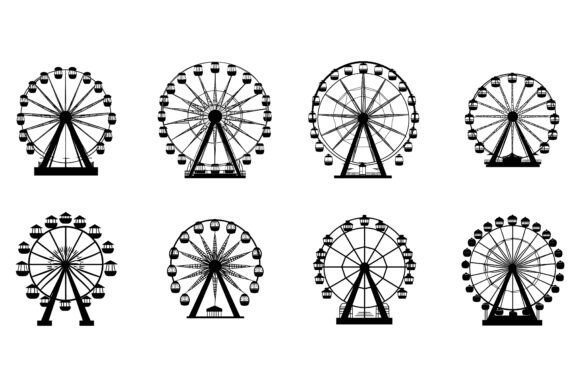
Carousel Silhouette Design Elements and Their Enduring Visual Appeal
Silhouettes possess a unique power in visual communication. They strip away surface detail to reveal pure form, creating imagery that resonates across cultures and contexts. The Carousel Silhouette stands out among these minimalist forms for its ability to evoke nostalgia, motion, and celebration all at once. Whether used in digital interfaces, printed materials, or branding systems, the carousel silhouette carries meanings that go far beyond its simple outline.
Design professionals across multiple disciplines have embraced the carousel silhouette for its versatility and emotional resonance. From children's book illustrations to sophisticated corporate presentations, this particular visual motif adapts remarkably well to different contexts. The rotary motion implied by the carousel form suggests continuity, cycles, and joyful repetition, making it a powerful metaphorical tool in visual storytelling.
Understanding the Structural Beauty of Carousel Silhouettes
A carousel silhouette captures the essential architecture of a merry-go-round without relying on color gradients, textures, or internal details. The recognizable canopy, the poles aligning with horses or other figures, and the circular platform all reduce to their purest shapes. This simplification demands precision from the designer because every curve and proportion must carry representational weight. When the details are stripped away, the quality of the line work and the accuracy of proportions become paramount.
The best carousel silhouette designs achieve a delicate balance between simplicity and recognizability. Too few elements and the form becomes abstract beyond recognition. Too many details and the silhouette loses its graphic impact. Professional illustrators spend considerable time refining anchor points and bezier curves to ensure the silhouette reads instantly while maintaining elegance. This attention to detail explains why well-crafted vector assets in AI and EPS formats hold such value for working designers.
Working with Carousel Silhouette illustrations requires an understanding of positive and negative space relationships. The empty areas between the carousel components become just as important as the solid shapes themselves. A carefully designed silhouette uses these negative spaces to suggest depth and structure without explicitly drawing them. Viewers perceive the overlapping forms and spatial relationships through these thoughtful gaps and intersections.
Vector Formats and the Advantages They Offer Designers
The availability of carousel silhouette illustrations in professional vector formats transforms how designers interact with these assets. AI EPS files preserve mathematical precision, allowing infinite scaling without quality degradation. This matters tremendously when a single illustration needs to appear on a business card one day and a trade show banner the next. The vector data describes curves and shapes through coordinate-based instructions rather than fixed pixel grids.
Designers working across both Mac and Windows platforms benefit from the cross-compatibility engineered into modern vector illustration sets. File structures organized with clear naming conventions and logical layer grouping reduce the friction of importing assets into ongoing projects. When every element sits on its own properly labeled layer, customization becomes straightforward rather than frustrating. Color adjustments, shape modifications, and compositional rearrangements happen efficiently, keeping creative momentum intact.
The organizational quality of illustration files directly impacts professional workflow speed. Neatly arranged layers and consistently named groups might seem like minor considerations, but they compound into significant time savings across multiple projects.Applications Across Media and Industry Sectors
The carousel silhouette finds natural homes in numerous creative and commercial contexts. Understanding how different sectors leverage this imagery reveals the breadth of its applicability.
Web designers incorporate carousel silhouettes into hero sections, loading animations, and background patterns. The recognizable shape creates immediate visual interest without overwhelming other page elements. When scaled down for mobile interfaces, the simplicity of silhouette art ensures legibility on smaller screens. App developers use these forms for onboarding illustrations, achievement badges, and navigational icons that benefit from the carousel's associations with entertainment and delight.
Print applications showcase the crispness of vector-based carousel silhouettes at their best. Brochures for family entertainment venues, festival programs, and community event posters all utilize this imagery to signal fun and approachability. The ability to edit colors means a single Carousel Silhouette illustration can adapt from playful pastels for a children's product to sophisticated metallic tones for an upscale event invitation. This color flexibility multiplies the utility of each illustration in a collection.
Infographic designers find carousel silhouettes particularly useful for representing cyclical processes, entertainment statistics, or historical timelines related to leisure and culture. The rotational nature of the carousel form provides a visual shorthand for concepts involving repetition, cycles, or phases. Data visualization benefits from this intuitive visual metaphor, helping viewers grasp abstract concepts through familiar imagery.
Customization Capabilities and Creative Control
The true power of professionally organized vector illustrations emerges in the customization phase. Designers rarely use stock assets in their original form. The ability to modify colors, adjust individual elements, recombine components, and adapt the illustration to specific brand guidelines determines whether an asset becomes a valuable resource or a digital dust collector.
Changing colors represents the most common customization need. Brand color palettes vary widely, and illustrations must harmonize with existing visual systems. Well-structured AI EPS files make color replacement straightforward, with properly defined swatches and organized color groups allowing global changes rather than tedious element-by-element adjustments. This capability transforms a generic illustration into a brand-specific asset in moments.
Perfection in details and consistency across illustration sets ensures that modified elements still look professionally crafted rather than amateurishly altered.Beyond color adjustments, designers frequently reshape elements to suit specific composition requirements. The carousel silhouette might need to appear at different angles, with certain features emphasized or de-emphasized based on the surrounding layout. Vector anchor points allow for precise shape modifications while maintaining smooth curves and clean intersections. This editability extends the useful life of illustration collections far beyond single-project applications.
Symbol and Icon Applications at Different Scales
The carousel silhouette reduces particularly well to icon and symbol sizes. At minimal dimensions, the distinctive canopy shape and circular base remain recognizable even when fine details disappear. This scalability makes carousel silhouettes effective choices for app symbols, wayfinding systems in physical spaces, and UI elements across digital products.
Symbol designers appreciate illustrations that maintain visual integrity through multiple size reductions. The structural clarity built into well-crafted carousel silhouettes ensures the form stays legible at 32 pixels square or smaller. This characteristic matters enormously for digital product designers who need icons to work across device sizes and resolutions. The same asset serving as a detailed illustration in one context might function as a simplified symbol in another, provided the foundational design quality supports both uses.
Consistency Across Illustration Collections
When building visual systems, consistency across related illustrations strengthens the overall design language. Illustration sets that maintain uniform line weights, stylistic approaches, and proportional relationships create cohesive visual experiences. This consistency proves especially important for multi-page documents, comprehensive branding systems, and digital products with numerous touchpoints.
The Carousel Silhouette illustrations within a well-organized collection relate stylistically to other assets, allowing designers to mix and match while maintaining visual harmony. Consistent rounding of corners, similar levels of geometric abstraction, and matching approaches to detail density ensure that assembled compositions look intentionally designed rather than haphazardly assembled from disparate sources.
Professional designers evaluate illustration sets not just on individual asset quality but on how the pieces work together as a system. The carousel silhouette should feel like part of a family with related amusement, entertainment, or lifestyle illustrations. This systemic thinking separates thoughtfully produced illustration collections from random assortments of clip art.
Integration Into Existing Design Workflows
The practical considerations of file compatibility and organizational structure determine how smoothly illustrations integrate into established design workflows. AI EPS formats work natively with industry-standard design software, eliminating conversion steps and format-related frustrations. Designers can open files directly, inspect layer structures, and begin customization immediately.
Cross-platform compatibility between Mac and Windows environments ensures that teams with mixed hardware can collaborate without file issues. Font rendering, color space interpretation, and layer naming conventions all maintain consistency across operating systems when files are properly prepared. This technical consideration might seem mundane, but it prevents the workflow interruptions and deadline pressures that arise from format incompatibilities.
Educational and Presentation Use Cases
Educators and presenters incorporate carousel silhouettes into learning materials and slide decks for their immediate visual appeal and metaphorical richness. The carousel suggests concepts of circular motion, historical entertainment, mechanical engineering, and cultural traditions. These layered meanings make the silhouette valuable for illustrating abstract concepts in accessible ways.
Researchers presenting findings on leisure studies, urban planning, or cultural history might use carousel silhouettes to anchor theoretical discussions in recognizable imagery. The silhouette avoids the distractions of photographic detail while providing a clear visual reference point. Audiences connect with the familiar shape while focusing their attention on the presented information rather than decorative elements.
Hobbyists creating personal projects find that professional-grade illustrations elevate their work significantly. Scrapbookers, DIY invitation designers, and community newsletter editors all benefit from accessing well-crafted vector assets. The editability of AI EPS files means these users can customize illustrations to their specific needs without starting from blank canvases or settling for lower-quality alternatives.
Evaluating Illustration Quality for Professional Use
Several markers distinguish professionally crafted carousel silhouette illustrations from amateur alternatives. Attention falls first on the smoothness of curves, where properly placed anchor points create flowing lines without visible bumps or irregularities. Second, proportional accuracy ensures the relationships between canopy, poles, platform, and figures feel natural and balanced. Third, consistency in line weight or fill approach maintains visual coherence throughout the illustration.
The structure of the file itself reveals much about the care invested in its creation. Well-organized layers named descriptively, grouped logically, and arranged intuitively speak to professional production standards. This organizational quality directly impacts the speed and ease of customization for end users. When every element is easily selectable and independently editable, the illustration becomes a flexible resource rather than a rigid asset.
Attention to detail in both the visible illustration and the underlying file structure indicates professional-grade work suitable for demanding commercial applications.Why Carousel Imagery Resonates Across Audiences
The carousel holds a distinctive place in cultural memory that spans generations and geographies. Unlike many nostalgic symbols that resonate primarily with specific age groups or regional audiences, the carousel crosses boundaries effectively. Children recognize the shape from playgrounds and amusement parks. Adults connect it to cherished memories and the broader iconography of entertainment history. This cross-generational and cross-cultural recognition makes the carousel silhouette an unusually versatile visual asset.
From a psychological perspective, circular motion carries positive associations that linear movement does not always share. Cycles suggest renewal, continuity, and completion rather than simple progression from point to point. The carousel specifically layers these positive associations with entertainment, community gathering, and celebration. Designers leveraging these psychological dimensions through silhouette imagery tap into deep wells of viewer response without needing to build these associations from scratch.
Technical Considerations for Different Output Formats
The inclusion of JPG versions alongside vector AI EPS files addresses different usage scenarios. While vectors serve as primary working files for designers requiring scalability and editability, raster JPG versions provide quick preview capabilities and instant usability for applications where vector precision is unnecessary. Web content management systems, email templates, and rapid prototyping situations benefit from the immediate accessibility of raster formats.
Print production demands the highest quality source files, and vector formats deliver the resolution independence that professional printing requires. Whether outputting to offset presses, digital printers, or large-format displays, vector-based carousel silhouettes maintain crisp edges and clean details at any reproduction size. This reliability across output methods makes vector illustrations the standard choice for serious design work.
The combination of formats within a single illustration collection acknowledges the practical realities of modern design workflows. Designers move between applications, share files with collaborators, and encounter varying technical requirements across projects. Having both AI EPS and JPG versions available reduces friction and keeps creative work moving forward efficiently.
Making Illustration Assets Work Harder Across Projects
Savvy designers maximize the value of their illustration collections by exploring varied applications for each asset. A single Carousel Silhouette might serve as a primary hero illustration in one project, a subtle background pattern element in another, and an app icon inspiration in a third. The editability of vector files enables this versatility, transforming what might seem like a single-use asset into a multifaceted design resource.
Color variations expand the useful range of any silhouette illustration exponentially. A monochromatic treatment suits minimalist branding applications. A gradient approach adds dimensional interest for digital interfaces. Multi-color treatments with carefully selected palettes adapt the same basic form to completely different aesthetic contexts. Each variation emerges from the same source file, preserving the detail and consistency of the original while enabling dramatically different visual expressions.
The ability to extract and recombine elements from illustration sets further extends their utility. Designers might isolate the canopy from one carousel illustration, combine it with architectural elements from another asset, and create something entirely new. This modular approach to illustration use treats vector assets as component libraries rather than finished, unalterable images.
Perfection in details means every element within an illustration set can stand alone when needed, giving designers maximum compositional freedom.Practical Considerations for Immediate Implementation
Designers evaluating illustration resources for their projects consider not just the visual quality but the practical path from purchase to implementation. Clear file organization, predictable naming conventions, and logical layer structures all reduce the time between acquisition and productive use. When files open cleanly, layers present themselves intuitively, and colors adjust easily, the illustration immediately begins contributing value rather than consuming time.
The cross-platform compatibility between Mac and Windows environments ensures that design teams with mixed hardware can collaborate seamlessly. This technical consideration prevents the frustrating scenario where an illustration works perfectly on one designer's machine but causes issues on another's. Properly prepared AI EPS files maintain their integrity across operating systems, allowing teams to focus on creative decisions rather than technical troubleshooting.
Professionally organized illustrations integrate into existing project structures without demanding special handling or workarounds. They behave as expected within design software, respond predictably to standard editing techniques, and export reliably to required output formats. This reliability allows designers to incorporate new assets into their workflow confidently, knowing the technical foundation supports rather than hinders their creative goals.