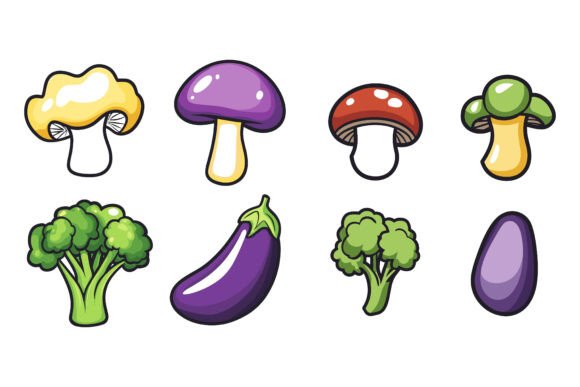
Set of Vegetable Stickers: Fresh AI EPS Illustrations
When a design calls for crisp, recognisable vegetable graphics, a well-built set of vegetable stickers can save hours of drawing time. This particular pack, part of the Hello Welcome special AI EPS Collections, gives you more than just cute icons — it delivers a structured, editable, and consistently styled library that works across everything from mobile app prototypes to large-format printed menus. Whether you’re an educator creating a healthy eating worksheet, a marketer designing a weekly farm box flyer, or a brand manager refreshing packaging icons, this set plugs right into real workflows.
The download includes three core file formats: Adobe Illustrator (AI), Encapsulated PostScript (EPS), and high-resolution JPG. That combination means you get full vector editability plus a ready-to-use raster option for people who don't work with vector tools. Because the files are designed for both Mac and Windows users, cross-platform friction disappears. A small detail that design teams notice: the layer structure inside the AI and EPS files is tidy. Objects are logically grouped, labelled, and separated, so isolating a single artichoke or recolouring a bunch of radishes takes seconds, not minutes.
What Makes This Collection Work So Well
Not all illustration sets are built with actual production in mind. Here, the emphasis on neat organisation and consistent line weights, shading, and perspective means you don't spend your morning fixing mismatched styles. Everything from a carrot to a pumpkin reads as part of the same family. That visual cohesion matters when you’re placing several stickers side by side on a web banner or a recipe card. It quietly signals attention to detail — a quality that reflects back on your own brand.
The pack includes a wide range of common vegetables: leafy greens, root vegetables, alliums, squashes, and nightshades. Because they’re created as fully scalable vectors, you can blow up a tomato sticker to billboard size or shrink a pea pod down to a tiny app icon without any loss of sharpness. That versatility is one reason people reach for AI EPS formats over flat PNGs.
Where This Set of Vegetable Stickers Fits Into Real Projects
Think beyond the kitchen. A handful of use cases shows how these illustrations adapt to different audiences and mediums:
- Food and beverage branding: Street food stall logos, organic product labels, farm-to-table restaurant menus, and juice bar window decals.
- Digital products: Gardening or nutrition tracking apps, recipe plugin UI elements, and interactive grocery list widgets.
- Educational content: Classroom posters about seasonal eating, school lunch programs, and children’s activity sheets for identifying vegetables.
- Infographics and editorial: Health magazine layouts, sustainability reports, and social media carousels that break down plant-based diets.
- Print materials: Seed packet designs, farmers market loyalty cards, community-supported agriculture (CSA) brochures, and reusable shopping bag prints.
In each scenario, the fact that you can change colours, adjust stroke thickness, and remove details without hunting through ungrouped layers turns a ready-made sticker into a custom asset. One designer recently recoloured the included beetroot and fennel to match a client’s earthy brand palette — a task that took under ten minutes and completely transformed the feel of the final booklet.
Editing Flexibility Without the Headache
Many illustrators supply EPS files that are essentially flattened, making them nearly impossible to modify. That’s not the case here. Every vegetable is drawn as a distinct, closed shape, often with separated highlights, shadows, and main fills. You can easily select a bell pepper’s body and swap its red for a yellow, or tweak the gradient on a cabbage leaf. This kind of control is crucial when you’re integrating stickers into an existing visual identity.
Because the AI file is the native format, users with Adobe Illustrator get the smoothest editing experience. However, the EPS format ensures that CorelDRAW, Affinity Designer, and even some layout applications can open and separate the elements. For quick placements, the included JPGs — with transparent backgrounds in many cases, depending on the export — let you drop a finished sticker into a presentation slide or blog post without ever launching a vector editor.
Organisation That Speeds Up Your Workflow
Open the file and you’ll immediately notice how intuitive the layer hierarchy is. Vegetables are grouped by type or by similar shape categories, and each group sits on its own clearly named layer. That means you can toggle off an entire set of root vegetables to focus on the leafy ones, or quickly isolate all the orange-hued items if you’re building a colour-themed chart. This level of organisation is especially valuable in collaborative environments where multiple people might need to pull assets from the same file.
For Mac and Windows users alike, the folder structure outside the design app is equally thought-out. You’re not faced with a single messy dump of files. Instead, the download typically separates AI, EPS, and JPG versions into their own folders, so you can hand the correct format to a web developer or a printer without additional sorting.
How Vegetable Graphics Strengthen Communication
Visual cues reduce cognitive load. A nutrition blog that pairs a smoothie recipe with a recognisable spinach sticker helps readers instantly understand the main ingredient. A restaurant menu using small carrot icons next to vegetarian dishes aids quick scanning. When these icons are finely detailed and uniform, they also give the page a polished, professional texture that photographs can’t always deliver — especially when you need a clean, illustrative aesthetic.
For entrepreneurs and small business owners, such a set of vegetable stickers lowers the barrier to producing quality visuals. Instead of hiring an illustrator for each new flyer, you maintain brand consistency by pulling from the same editable pack. The time savings compound quickly: a Saturday morning spent creating an Instagram story about a seasonal produce box becomes a 20‑minute assembly task when the core graphics are already on hand.
Print, Screen, and Everything in Between
The AI and EPS origins mean these stickers are equally at home in 300 DPI offset printing and on retina displays. You won’t see pixelation when you enlarge a kale leaf for a storefront window graphic, nor will the edges look fuzzy when you export a squash icon at 2x or 3x for a mobile app. The consistent level of detail — tiny veins on a cabbage, subtle dimples on a tomato — holds up across contexts, which is a major advantage over cheaper, overly simplified icon sets.
And because the files are designed to be modified, you can extract just the outline of any vegetable to create a line-art version for colouring books or embroidery patterns. A handful of educators have already used that trick to produce engaging worksheets that children can colour while learning plant names — a simple idea that leverages the vector backbone of AI and EPS formats.
Choosing and Using the Set Wisely
Before you dive in, it helps to confirm that your primary design software can read AI or EPS files without altering complex gradients. Most modern tools handle them well, but if you rely solely on browser-based editors, you might find the JPG versions more immediately usable. The good news is the trio of formats covers that gap nicely.
When integrating the stickers into a larger brand system, take a moment to sample the dominant colours from a few key vegetables and see how they sit alongside your existing palette. Because editing is so straightforward, you can shift the whole collection toward warmer or cooler tones, or even create a monochromatic outline style, while the original intact layers preserve your ability to revert.
Lastly, consider the narrative power of grouping certain stickers together. A row of root vegetables placed below the soil line in an infographic tells a story about regenerative farming without a single word. A circular arrangement of salad ingredients becomes an inviting round badge for a food website header. The more you play with the assets, the more you realise they aren’t just decorations — they’re a lightweight visual language that you can shape to your own message.
Having a reliable, detailed, and properly structured set of vegetable stickers on your hard drive changes the speed at which you can respond to creative briefs. This particular collection marries the technical polish professionals expect with the ease-of-use that part-time creators appreciate. From the moment you open the file to the final export, the hours you don’t lose fighting messy layers become hours you invest in the actual design — and that’s a trade-off worth making.